Our final stop: Vanuatu. A cluster of 80+ islands in the South Pacific, Vanuatu is a tropical destination that transports you beyond the reach of modern civilization; a place of idyllic deserted beaches and thatched-roof villages, where tribal chiefs gather their council under the shade of a banyan tree and ancient customs are still very much a part of every-day life, a place that feels a step back in time.
As we landed in Port Vila on the main island of Efate, we peered out the window at the mountainous palm-speckled landscape, dense green jungle with simple thatched-roof homes visible amidst rustic farms. The plane circled the tiny taxiway, and we noticed three young children at the edge, their fingers twined in the chain-link fence, the property line of their family farm bordering the airstrip – they’d gathered to watch the spectacle of a plane landing.


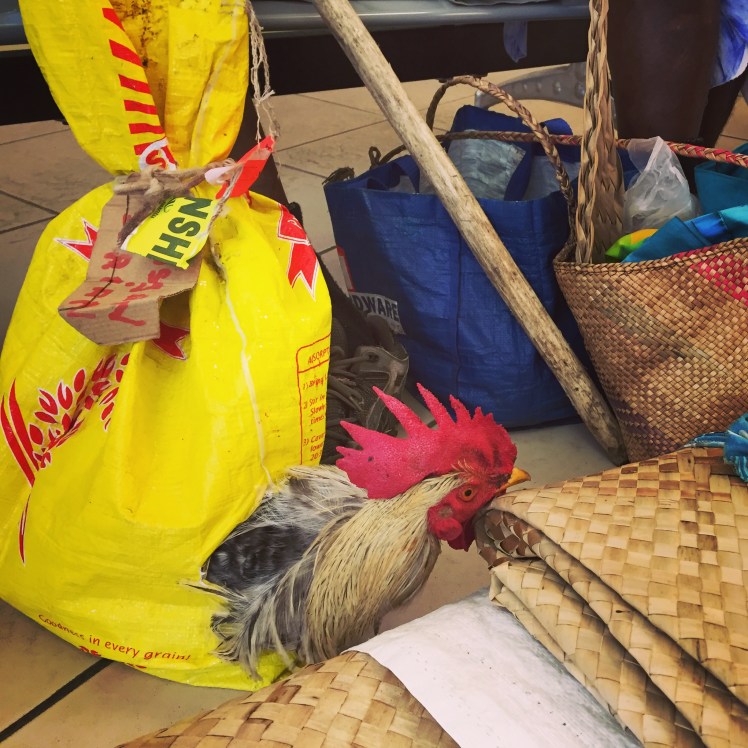
This is a rural place. While waiting at baggage claim (i.e., a stretch of tables where bags were unceremoniously dropped), we were amused by some of the checked luggage from locals: a whole watermelon, unwrapped, its owner’s name scrawled directly on the rind in black Sharpie, and a live rooster, scarlet head poking through the old plastic rice bag that served as its “carrying case”.
We had one more island hop before our final destination of Espiritu Santo; we passed the time in the one-room Port Villa airport waiting for our flight, playing card games and snacking on popcorn freshly popped from one of those old fairground poppers that reminded us of elementary school recess. By the time our flight delivered us to Luganville, it was dark and rainy. Our chatty driver told stories and pointed out sights along the way – the agricultural college paid for by the Chinese government, the newly paved roads compliments of the American government – none of which we could see, the dimly lit roads obscured by steamy tinted windows of the van we rode in.
Our hotel, Sunrise Beach Cabanas Eco-Resort, is on the east side of the island, about a 20 minute drive from the airport. Claire and her staff welcomed us with fresh juice and giant umbrellas to escort us to our cabana on the beach. We settled in, ready for a good night’s sleep, leaving the windows open and the curtains pulled back to better hear the rain and waves outside.
When dawn broke, the rising sun lighting up our room, we woke to discover our own personal paradise…we made coffee in our little kitchen and stepped outside to admire the white sand beaches below our cabana bungalow, shadowy coral reefs visible in the shallow turquoise waters. It was low tide, which exposed a sandbar path leading to a small uninhabited island 100 feet off the shore. It was barely 6am, and we couldn’t wait to explore.


The first few days, we were content to stay put – Sunrise and its gorgeous corner of the world has so much to offer. We’d brought our own masks & snorkels, and Sunrise Beach Cabanas provided kayaks and stand-up paddle boards for guests to use. Steps from the shore are astounding reefs, home to multiple species of Clown Fish. These little fish of Nemo fame are extremely territorial, and fearlessly charge human trespassers; at first we mistook this for playfulness… until we realized that we were most likely terrorizing them, and gave them a little more distance.


One morning, while exploring the mangrove-sheltered side of the beach, we had our one and only snake encounter of the entire trip: an elegant black and silver striped sea krait. We watched, frozen, as it smoothly navigated the tide pools, passing not 3 feet in front of us as it headed to the open sea. This happened to the be the one day that we did not carry phones or other photographic equipment, so the image lives in memory only – and you’ll have to trust our word that we did see it!


When we were ready to start venturing beyond our Sunrise bungalow, we enlisted the help of a driver to take us up the island’s East Coast Road.


We visited Champagne Beach at the north end of the island, famous for its arc of pristine white sand beach. It is apparently a newer destination for cruise ships, when 2000 visitors will descend upon the shores in one massive frenzy. When we arrived, however, it was blissfully abandoned, the only other souls on the beach were a herd of sleepy cows.


Afterwards, we stopped in Port Olry for lunch – we ordered the local specialties: coconut crab and lobster. We devoured the meal with our hands, washing it down with bottles of cold Tusker.


One of our “must-do” experiences for Vanuatu was to try kava. Chad had read about it in a book, Getting Stoned with Savages, and Lindsay was game for trying the local spirit. Kava bars – called nakamals – are prolific on the island; they are recognizable by a discreet lantern visible from the street – if lit up, that indicates they are open for business, usually starting around 4pm.


Kava is made from the roots of the native shrub of the same name. We were told by several people not to eat before drinking kava – a somewhat foreboding instruction that didn’t inspire a lot of enthusiasm – but it was surprisingly inoffensive. The greyish murky liquid has a pungent earthy flavor, and is served in 50g or 100g portions; the proper way to drink it is to gulp it down in one go. Chad drank two of the larger portions, Lindsay tried just one of the smaller. The only noticeable affect was an immediate numbing of the inside of our mouths. We’ll stick with the Tuskers!
Now reading…
Lindsay: News of the World, by Paulette Jiles
Chad: The Prize, by Daniel Yergin


Well written
LikeLike
Chad and Lindsay, What a great Vanuatu adventure story!
Thank you for coming and staying with us at the beach cabanas and sharing about all the many interesting aspects of your island discoveries! Beautiful!
LikeLike